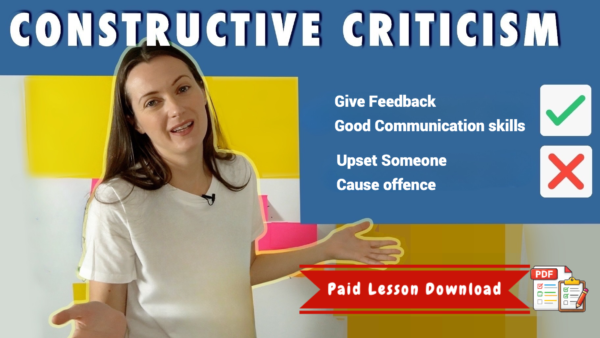
Giving constructive criticism is an essential communication skill, but it’s one many people find difficult. Most people don’t enjoy being criticised, even when feedback is necessary or well-intentioned. This lesson introduces a clear, practical formula for giving honest opinions on someone’s creative work—such as writing, art, or photography—without causing offence or making the other person take it personally.

What is constructive criticism?

The word ‘criticism’ and related words, like ‘critic’ and ‘critical’, derives from an ancient Greek word ‘krino‘, which means “I judge”.

People do not like being judged. When you offer your criticism, people feel like they are being judged; and this is why some of us are able to take it, and others just can’t take criticism at all.

Constructive criticism refers to criticism that is delivered in a tactful manner. The opposite kind of criticism is called destructive criticism. But that being said, many people are averse to receiving any kind of criticism!

Before you criticise… Stop and think!

Before you criticise, I want you to stop and think.

1. Is what you’ve got to say tactful? meaning, are you delivering it in a sensitive way?

2. Are you demonstrating that you have emotional intelligence, which means an understanding of how that person might react when you criticise their work? When you have emotional intelligence, you’re able to make a judgment about what kind of criticism you can give to that person.

3. Have you considered whether you should be giving any feedback at all? We must consider the boundaries between people. Maybe it is not your place to criticise that person’s work. I can think about my own personal experience when I was a university student. When my lecturers criticised my work and gave me suggestions for improvement, it was welcomed. However, when my peers, the other students on the course, did the same thing, I usually did not welcome that.

4. Is the feedback going to be helpful to them? Is your criticism really needed? Will it make a difference to the current work or future work? If not, it may be better to keep it to yourself.

5. Is the feedback going to be achievable? Is the feedback is too advanced or beyond their level of skill?

I want you to think about all of these points before you apply the magic formula, because the magic formula can’t work if you’re trying to give criticism where it is not appropriate.

How to Give Good Constructive Criticism

The magic formula is sometimes called a compliment sandwich. You give someone a compliment, but you follow it with an observation which is negative.

“I really like how you did ‘X’ (Put your positive observation here), but I think ‘Y’ (Put your criticism here) needs a little more attention”

It’s a way of softening your criticism, because you’re giving them something motivating, but then, after that, you’re just saying, oh, there’s this small issue over here that you should maybe have a look at.

Let’s make this real by giving an example. Imagine I am talking about your painting:

I really like how you did the background, but I think your subject needs a little more attention.

You may need to change the verb “did”. For example, you may say: I really like how you ‘depicted’, how you ‘demonstrated’, how you ‘illustrated’, how you ‘evoked’. We can use all kinds of descriptive verbs there.

Constructive Criticism Examples

“It was unclear in parts”
A softer way of suggesting the work is not particularly good in some parts. The use of “it” keeps the criticism focused on the work itself and does not feel like a personal attack on the creator of the work.

X could be developed further”
A way of suggesting the person can add more to a specific part. They can make it longer or redo that part of the work. This type of criticism is a little bit vague and you are leaving it up to the other person to decide what you mean and whether they should amend their work.

“You might rework the X a touch”
“Rework” means do again and “a touch” means a little bit. For example, “You might rework the conclusion a touch”.

“It might be worth rethinking that part” 
This is a softer way of suggesting that somebody makes a change.

Now we can soften it one step further, which is we can use expressions such as “in the future”, “if you have time”, or “next time”.

For example:

In the future, you might consider making the introduction a bit longer.

Techniques to Give Positive Feedback

Hedging language makes your opinion softer and more tactful. It may not be good to use this language when you want to sound assertive or confident. However, when we are giving someone criticism, it can be kinder to express criticism using hedging language.

List of Hedging Phrases Used in English

We can say:

a bit, a little, somewhat, slightly, maybe, perhaps, sometimes, a touch, could be, might be.

You can place these in the phrases I demonstarted earlier on. Then, when you are giving someone criticism, they’ll be able to take what you’re saying without getting upset or offended.


Extend your Learning

⏵ Speak better English by taking one of Jade’s courses

⏵ Book a one-to-one accent training lesson with Jade


Author

Jade Joddle grows your confidence and skill to shine when speaking English.

Comments are closed.