
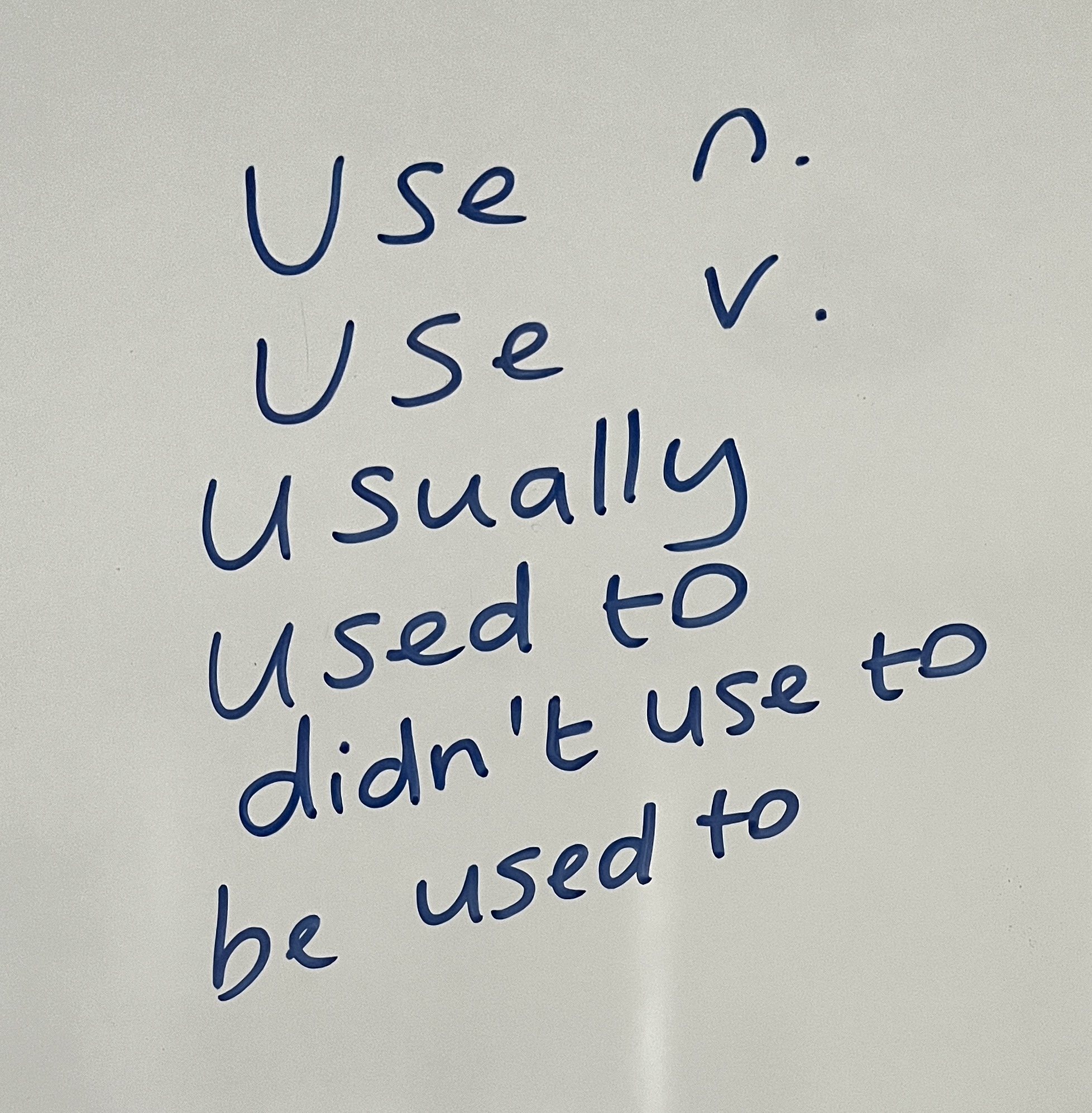
In this English lesson on confusing words, you will learn the difference between use, used to, and usually. These words are often confused by English learners because they sound similar but have different meanings and pronunciations. In this lesson, you will practise using use, used to, and usually correctly in clear example sentences.
For each confusing English word, we will learn the meaning and practise the word in an example sentence. Watch the video version of this lesson below:
Confusing Words One: ‘Use’ as a Noun
The word ‘use’ as a noun is pronounced with a final /s/ sound. It refers to the purpose of something or the act of using something.
-
This cup is intended for single use.
-
The use of drugs is illegal.
-
This room is for staff use only.
The word ‘use’ is also used commonly in the expression, ‘There is no use trying to change my mind’. It means any effort to change my mind is futile.
Confusing Words Two: ‘Use’ as a Verb
The noun and verb of the word ‘use’ have different pronunciations but the same spelling. This results in students confusing these words and making pronunciation errors. The difference between them is simple when we remember that the verb ‘use’ is pronounced with a final /z/ sound in the present tense –> /juːz/.
- Can I use your pen?
- I don’t know how to use this tool.
- Ask Peter if you can use his laptop.
Used to Meaning
The verb ‘used to’ is a confusing word because we only use it in the past tense. A second reason we find this English word confusing is because it is a two-part verb: use + to.
We use this verb to talk about things that we regularly did in the past, but which no longer happen.
- I used to live in Amsterdam.
- She used to play the guitar.
- We used to go clubbing every weekend.
The word ‘used to’ is also a commonly mispronounced word in English. Notice that there is no final /d/ pronounced in the word, so in fact, it sounds like ‘use to’. That’s confusing! → /juːs tu/
Confusing Words in English: Usually
Some intermediate level students get the word ‘usually’ (adverb) mixed up with ‘used to’ (see above) because both words are commonly used when talking about habits. We use the word ‘usually’ (adverb) when talking about what happens most of the time; it has the same meaning as ‘normally’.
I usually / normally wake up at 7am.
I used to wake up at 7am. *This sentence means you don’t wake up at this time anymore.
To remember the difference between these confusing words, note that ‘usually’ is a word with a soft sound, which is pronounced /ˈjuːʒ.ə.li/. In contrast, ‘used to’ /juːs tu/ has a hard /t/ sound in the pronunciation.
Be Used to Something Meaning
‘Be used to’ is an expression that is used for talking about something that you are accustomed to doing. It is commonly confused with ‘used to do’ something, which refers to a past habit.
Sentence examples:
- Person A: “You get up at 5am every morning!” → Person B: “It’s okay, I’m used to it.”
- I’m not used to driving on the left side of the road.
- We’re not used to the noise of city life.
I used to like him. *This refers to a past state that is over.
Confusing Words in English: Didn’t Use to
‘Didn’t use to’ is used to talk about a past habit that has changed. It is confusing because it sounds the same as ‘used to’. Notice that there is no ‘d’ in the spelling, but it has a /t/ sound → /juːs tu/
I didn’t use to exercise. *I didn’t exercise in the past, but I do now.
Mary didn’t use to be overweight. *She wasn’t fat before, but she is now.
Didn’t you use to work at Tesco? *In the past you were employed there, but not now.
Extend Your Learning
▶︎ More confusing Words in English: Wonder vs Wander
▶︎ Words that sound the same but have different meanings and spellings: Homophones Practice.

Comments are closed.